
Autonomy Safety
Separating intelligent decision from unchecked release.
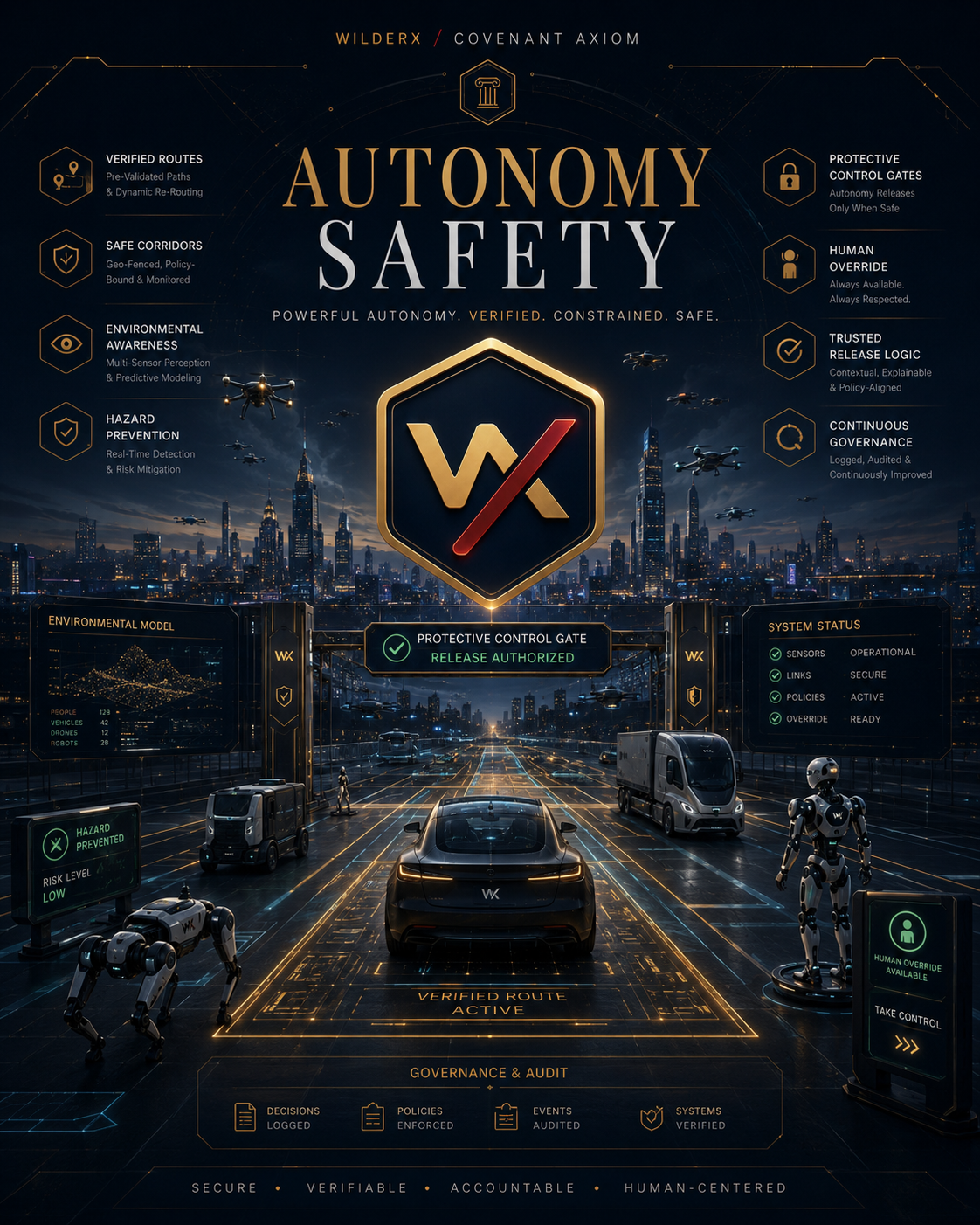
Autonomy Safety
WilderX supports autonomy by separating intelligent navigation or decision-making from unchecked physical release. Autonomous vehicles, drones, robots, and mobile systems should operate through verified routes, environment truth, human override readiness, and controlled action gates.
High-level company overview · Additional technical materials available through appropriate private review channels
What this chapter governs.
Autonomy Safety, in the Wilder X sense, is the discipline of separating an autonomous system's intelligent navigation or decision-making from its unchecked physical release — so vehicles, drones, robots, and mobile systems operate only through verified routes, environmental truth, and controlled action gates.
- The gate between an autonomous decision and a physical output
- Route legality, geofence integrity, and environmental sufficiency
- Human override readiness, hand-off, and denial pathways
- Behavior at the boundary of the operational design domain
- That an autonomy stack's confidence is real-world safety
- That a valid map is a valid current environment
- That connectivity is authority
- That absence of override is presence of consent
How discipline is maintained.
Route Validity
The intended path is verified as legal, safe, and permitted end-to-end before release.
Environmental Truth
Perception is cross-checked against independent sensing; assumptions are named.
Bounded Autonomy
Operational domain is explicit; behavior at the edge is defined, not emergent.
Override Readiness
A verified human override channel is always present, always evidenced.
Denial Over Guess
When sufficiency fails, the system denies release — it does not extrapolate.
Restoration Path
A safe, reachable posture is always available on loss of sufficiency.
Sequence of a governed action.
- 01Mission or maneuver proposed by the autonomy stack.
- 02Route validity, geofence, and environment truth cross-checked.
- 03Identity, authority, and override readiness verified.
- 04Energy, machine readiness, and interlock zone confirmed.
- 05Protected-Output Release Gate authorizes motion — or denies with reason.
- 06Continuous re-verification during motion; safe-state on loss of sufficiency.
- 07Evidence sealed; restoration path documented.
Public overview · Full engineering detail released through private review