
Machine Networks
Connected machines as governed participants.
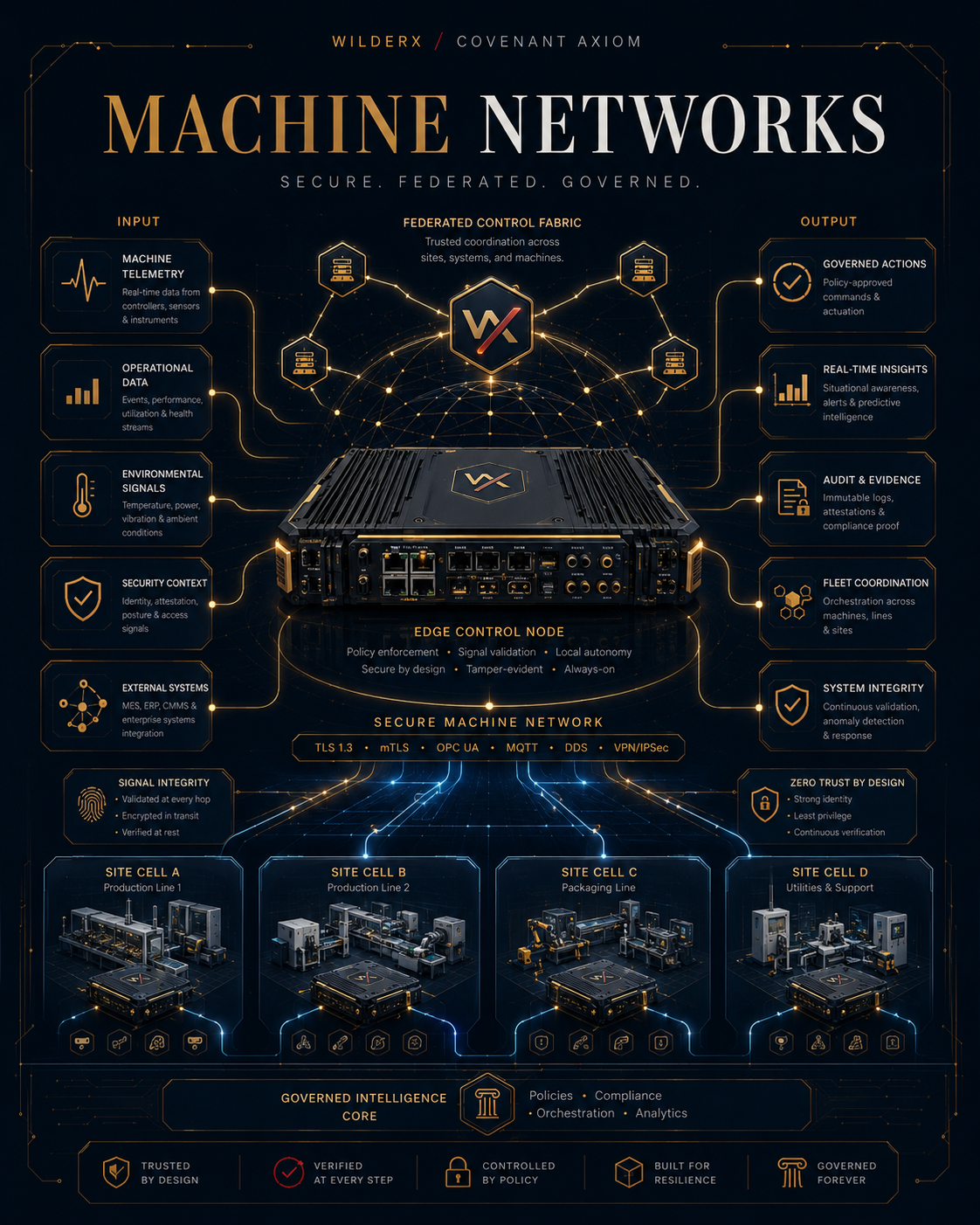
Machine Networks
WilderX treats connected machines as governed participants in a trusted operating network, not isolated devices acting on raw commands. The focus is secure coordination across sensors, controllers, edge nodes, machines, sites, evidence trails, and policy-bound release logic.
High-level company overview · Additional technical materials available through appropriate private review channels
What this chapter governs.
Machine Networks, in the Wilder X sense, are governed operating fabrics — the connected devices, robots, nodes, and control layers coordinated so that capability is released only under verified conditions, with evidence and restoration carried across the network itself.
- The transport of authorization, evidence, denial, and restoration signals
- Cross-attestation between devices before joint action is permitted
- Segmentation, isolation, and quarantine of untrusted or unverified nodes
- Consistent policy enforcement across edge, gateway, and core
- That connectivity is authority
- That an authenticated device is an authorized actor for this action
- That network health is application readiness
- That the last-known state is the current state
How discipline is maintained.
Verified Interlock Zone
Governing subsystems cross-attest each other before joint release.
Policy at Every Hop
Sufficiency is checked at the edge, not just at the origin.
Evidence in Transit
Actions carry their sufficiency evidence with them across the fabric.
Segmented by Duty
Networks are shaped by governance duty, not by device class alone.
Denial Is Reachable
Every node can be told — and can prove it heard — to stand down.
Restoration is Coordinated
Return-to-safe-state is a network behavior, not a per-device accident.
Sequence of a governed action.
- 01Nodes enrolled with verified identity and scoped authority.
- 02Cross-attestation established across the interlock zone.
- 03Intent published with sufficiency claims and evidence pointers.
- 04Peers verify sufficiency locally before honoring release.
- 05Protected-Output Release Gate opens per node — or denial propagates.
- 06Action executed with continuous evidence sealing across the fabric.
- 07Coordinated safe-state and restoration on any loss of sufficiency.
Public overview · Full engineering detail released through private review